Published on: April 24, 2026
Evaluating product catalog software feels straightforward until the procurement process begins. Stakeholders from marketing, operations, IT, and sales each carry different requirements into the decision. Two platforms can look nearly identical on the surface, both produce interactive flipbooks, both allow teams to share catalogs via links, and both offer some version of analytics.
Then the questions get specific: Can pricing sync automatically from our ERP? Can regional sales managers generate sub-catalogs without contacting design? Can buyers submit a shopping list or request a quote directly from the catalog? Will outdated SKUs ever circulate again? What is the total cost of ownership when manual catalog maintenance hours are factored in?
Those questions expose a fundamental divide. Some platforms were built for content publishing. Others were built specifically for enterprise-grade product catalog operations. Choosing incorrectly means managing workarounds indefinitely, as catalog volume grows and operational expectations rise.
Many enterprise teams arrive here already searching for an Issuu alternative for enterprise catalog operations, having hit specific operational ceilings their current platform was never designed to clear. This guide compares Catalogy and Issuu directly. Both tools serve real use cases. Neither is universally superior. What matters is whether a platform was designed for your specific operational reality.
Digital publishing platforms convert documents, PDFs, InDesign files, and PowerPoint presentations into interactive, shareable flipbooks. Issuu belongs to this category. Primary users include content creators, publishers, marketing agencies, and small businesses that need visually polished, easily distributable digital documents. Catalog creation happens as one use case among many.
Product catalog automation platforms treat catalogs as living data systems rather than static documents. Catalogy belongs to this category. Primary users are marketing, operations and sales teams at product-heavy companies managing hundreds to tens of thousands of SKUs across regions, channels, and partner networks. Catalog creation is the entire purpose.
Neither category is inherently superior. Asking which is better without specifying context is like asking whether a CMS is better than a PIM. The answer depends entirely on what problem your team actually carries into work every morning.
Use these questions as a diagnostic. Answers will determine which category of software matches your operational reality.
If product specifications, pricing, availability, and imagery sit in an ERP, PIM, or structured spreadsheet, your catalog workflow requires a platform capable of ingesting, organizing, and updating that data automatically. Manually re-exporting and re-uploading creates version drift, the condition where multiple catalog versions circulate simultaneously, each reflecting a different moment in your pricing or inventory history.
Single-user publishing is fundamentally different from multi-team catalog governance. When sales managers, regional coordinators, channel partners, and marketing teams all need catalog access simultaneously, with different permission levels and branded template constraints, infrastructure matters.
Organizations managing multiple brands from a single platform face an additional layer of complexity: each brand requires its own governance rules, template frameworks, and distribution controls. Brand consistency at scale and multi-brand management at scale require role-based access, reusable template frameworks, and centralized collaboration workflows, not individual publishing accounts.
Organizations managing seasonal launches, promotional cycles, supply fluctuations or regional pricing variations cannot maintain catalog accuracy through manual re-export workflows. Each data change that requires a human to rebuild, re-export, and redistribute a catalog introduces latency and error probability.
Frequent data changes require automated synchronization between source systems and published catalogs.
Multi-market catalog operations require more than translation. Pricing variations, product availability differences, regulatory compliance requirements, and regional brand adaptations all demand a catalog infrastructure capable of managing localized content from a centralized operational framework.
Publishing a single document in multiple languages is categorically different from managing region-specific catalog variants with shared brand governance.
If sales representatives use catalogs as discovery tools during buyer conversations, catalog engagement data becomes commercially valuable.
Knowing which pages a prospect spent time on before a follow-up call, which products generated the most interaction, and which sections buyers returned to repeatedly transforms catalog distribution into a sales intelligence function. Beyond engagement tracking, catalogs embedded on your website or shared via trackable links can capture leads directly, gating specific content or collecting buyer information without routing prospects through separate forms or landing pages.
Generic view counts are insufficient for sophisticated sales enablement.

The table below evaluates both platforms across the dimensions that matter most to enterprise marketing, operations, and sales teams. Assessments reflect documented capabilities, verified user reviews, and publicly available product information.
Issuu is a capable content publishing platform with genuine strengths: broad audience discoverability, fast PDF-to-flipbook conversion, and a simple embed experience. Content creators, small publishers, and marketing teams with modest, data-light catalog volumes use it effectively.
Where enterprise catalog operations create friction:
Product changes require rebuilding and re-uploading source documents manually. No native ERP or PIM integration exists, making real-time accuracy structurally impossible.
Platform branding stays visible unless organizations upgrade, creating a dependency that dedicated white-label catalog infrastructure eliminates by default.
Document volume caps, user seat limits, and absent automation capabilities surface as catalog operations grow across markets, teams, and partner networks.
Without enforced template constraints, regional teams diverge from brand standards. No platform-level guardrails exist to prevent inconsistency at scale.
Granular product-level engagement data, which SKUs drove interest, which buyers spent time on, and which category requires additional tooling not available natively.
Verified enterprise users have consistently flagged limited human escalation pathways and billing complexity. No dedicated account management is included at any plan tier.
Years of distributed embed codes, shared links, and institutional workflow familiarity create inertia. Procurement teams evaluating any platform at scale should assess data portability and the vendor's pricing trajectory before committing.
Every limitation listed above exists because Issuu was designed to solve a publishing problem. Catalogy was designed to solve an entirely different one: how product-heavy companies turn raw data into accurate, branded, commercially active catalogs at scale, across teams, without rebuilding anything manually.
Powered by Flipsnack, Catalogy brings a decade of enterprise catalog infrastructure to organizations that have outgrown general publishing tools. Brands including Pandora, Electrolux, L'Oreal and Converse operate on this foundation. Here is what changes operationally when the platform fits the actual problem.
Data connection eliminates manual maintenance. Catalogy connects directly to ERP and PIM systems, populating catalog templates automatically making outdated pricing or discontinued products circulating among sales teams structurally impossible.
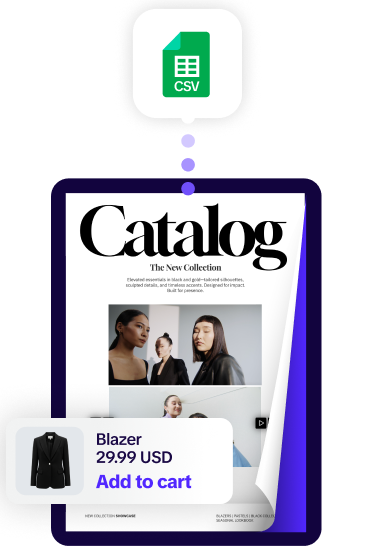
Automated generation compresses production timelines. Complete, formatted catalogs generate from CSV, spreadsheet or direct system integration in minutes, compressing cycles that previously consumed weeks of designer time.
White-label catalog delivery protects brand integrity. Every catalog carries your brand identity on your custom domain brand-locked templates, zero third-party visual presence, by default across every plan.
Scalability is architectural, not a pricing tier. Managing 50 catalogs or 5,000, across one region or twenty, operates within the same infrastructure framework without renegotiating the platform relationship.
Brand governance enforced at the template level. Sales managers and regional teams generate market-specific variants within approved templates without design involvement, consistency becomes structural, not procedural.
Role-based access matches organizational complexity. Marketing leadership, regional managers, channel partners and distributors each receive precisely scoped access, with SSO and SAML authentication integrated into existing enterprise identity infrastructure.
Interactive commerce converts engagement into revenue signals. Buyers build shopping lists, submit quote requests and initiate pre-orders directly from catalog pages giving sales teams structured buyer intent data before any follow-up call.
Collaboration workflows replace approval bottlenecks. Approvals, template constraints and version controls operate at the platform level, eliminating the email chains and design queue delays that slow catalog-dependent sales cycles.
Lead capture converts catalog engagement into pipeline. Embedded catalogs gate content, collect buyer information and sync leads directly to HubSpot, Salesforce and other CRM systems with full visibility on who engaged and when.
Multi-brand management from a single framework. Multiple product lines, sub-brands or regional markets each operate independently within shared infrastructure, eliminating the fragmentation of separate platform accounts.
ROI visibility replaces catalog distribution as a cost center. Revenue analytics and order attribution give leadership a measurable connection between catalog activity and commercial outcomes.
Support model built for enterprise accountability. Every plan includes dedicated onboarding, ongoing training and a named account team not a generic support portal with specialists who know your specific data architecture and integration setup.
Use this diagnostic honestly. These patterns appear in organizations that have been managing catalog operations with publishing tools longer than their operational complexity warrants.
Sales representatives share the most recent version they have, not necessarily the current version. Buyers receive pricing or product information that no longer reflects actual availability. Version drift is not a procedural challenge; it is an architectural one.
Every pricing update, product change or regional adaptation requires a design ticket. Marketing teams wait days or weeks for catalog corrections that should propagate automatically. When catalog maintenance competes with creative work for designer time, the underlying infrastructure is misaligned with operational scale.
Prospects interested in specific products must exit the catalog, navigate to separate channels and initiate separate purchase or inquiry workflows. Each friction point reduces conversion probability. Modern catalog infrastructure collapses the distance between product discovery and buyer action.
Issuu serves its intended audience well. Content creators, publishers, and marketing teams with straightforward digital publishing needs have used it effectively for years. General-purpose content publishing is what Issuu was built for.
Catalogy was built for a categorically different operational reality: product-heavy companies where catalogs are a commercial infrastructure rather than content assets. Organizations where pricing accuracy, brand consistency, and sales enablement capability are non-negotiable. Environments where catalog operations need to scale alongside SKU growth, regional expansion, and evolving buyer expectations.
Growing companies don't outgrow Issuu because Issuu gets worse. Growth itself creates catalog complexity that general publishing tools were never designed to absorb.
If your team answers yes to even two of the diagnostic questions above, your catalog infrastructure deserves a more precise fit.
Does Catalogy support SSO and SAML authentication?
Yes. Catalogy supports Single Sign-On and SAML authentication, integrating with existing enterprise identity infrastructure. IT administrators manage access centrally, and team members authenticate through existing credentials rather than maintaining a separate platform login. For enterprise security and compliance teams, this removes a meaningful access governance gap.
How does Catalogy handle migration from an existing catalog platform?
Catalogy's onboarding team manages the full migration process: product data transfer, template development, integration configuration, and go-live support. Organizations moving away from Issuu or another publishing platform do not rebuild from scratch. Data portability is part of the implementation scope, and dedicated account specialists guide each stage rather than leaving teams to self-navigate a transition.
Does Catalogy support collaboration across multiple teams and approval workflows?
Yes. Marketing administrators, regional managers, sales teams, and external partners each operate within structured workflows simultaneously. Template constraints, role-based access and approval controls are enforced at the platform level, not managed through email or shared folder conventions. Multi-team catalog operations work from a single governance framework rather than multiple disconnected processes.
What is the total cost of ownership difference between Catalogy and Issuu?
Issuu's sticker price appears lower. When TCO is calculated honestly, factoring in designer hours consumed by manual catalog updates, version control overhead, the operational cost of outdated materials circulating among sales teams, and the revenue impact of delayed launches, self-serve publishing platforms carry a substantial hidden cost. Catalogy's custom pricing reflects the infrastructure investment; the measurable reduction in manual overhead and version drift typically closes the gap within the first operational cycle.
Can Catalogy catalogs be embedded on our website with a custom domain?
Yes. Catalogy delivers catalogs on your custom domain with full white-label presentation. Embeds, shareable links, and QR codes all carry your brand identity with no third-party platform branding present. Catalogs embedded across multiple sites remain accurate automatically; a data change in the source system propagates to every embedded instance without any manual update or re-publishing step.
Where can we find independent reviews of Issuu and Catalogy?
Issuu has an established review presence on G2 and Capterra. Enterprise-specific feedback on both platforms, covering support responsiveness, pricing changes, and feature limitations, can be found across both directories. Catalogy's enterprise track record is documented through implementations with globally recognized brands, including Pandora, Electrolux, and L'Oreal, all operating on the Flipsnack infrastructure powering Catalogy.
Is Catalogy a genuine Issuu alternative for enterprise teams?
Catalogy and Issuu serve different operational categories. Issuu was built for content publishing at scale. Catalogy was built specifically for enterprise product catalog automation, with native product data integration, white-label delivery, role-based governance, and a dedicated support model. Teams reaching the operational ceiling of a general publishing platform consistently find that Catalogy resolves the structural limitations that workarounds cannot.
Does Catalogy offer white-label catalog delivery?
Yes. Catalogy delivers fully white-label catalog experiences. Buyers, partners, and distributors interact with catalogs on your domain, carrying your brand identity with no third-party platform branding present. Custom domains, brand-locked templates, and controlled access are standard across implementations, not premium additions.
Can Issuu integrate with an ERP or PIM system?
Issuu does not offer native ERP or PIM integration. Product data must be incorporated into source documents before upload. Organizations requiring automated synchronization between operational data systems and published catalogs need a platform with native data connectivity.
How long does Catalogy implementation take?
Catalogy's team manages the full onboarding process, including data connections, branded template development, and integration configuration. Most enterprise implementations reach initial launch within weeks rather than months. The complexity of existing data systems and organizational scope affects precise timelines.
Is Catalogy appropriate for a company with fewer than 500 SKUs?
Catalogy's design services and automation capabilities scale across catalog sizes. Organizations managing smaller product assortments benefit from the same real-time data synchronization, brand governance, and sales enablement functionality available to enterprises managing tens of thousands of SKUs. Contact the Catalogy team to assess fit for your specific volume and workflow.