
Published on: February 7, 2026
Enterprise companies do not lack product data. They lack connected systems.
ERP platforms manage pricing, stock, SKUs, and operational records. PIM systems centralize descriptions, images, attributes, and classifications.
Yet catalog production often lives outside that ecosystem.
Spreadsheets. Static PDFs. Manual exports. Repetitive formatting.
That disconnect creates friction between data management and revenue execution.
Catalogy closes that gap.
In mid-market and enterprise environments, ERP and PIM systems are already structured for operational excellence. They consolidate information, standardize data governance, and control accuracy.
However, when marketing builds catalogs manually, that structured architecture collapses into fragmented workflows.
This is not a design inefficiency. It is a systems integration gap.
Without ERP-to-catalog integration, organizations operate in parallel silos.
ERP integration should not stop at finance or logistics.
When product data flows seamlessly between systems, organizations achieve:
Catalog production must be part of that connected ecosystem.
If ERP and PIM are your operational backbone, your catalog infrastructure should be connected to that backbone.
Catalogy makes that possible.
Enterprise product data is already structured, validated, and governed inside ERP and PIM systems. Yet when that same data needs to power customer-facing catalogs, teams often revert to manual exports, spreadsheet manipulation, and repetitive formatting.
Catalogy eliminates that disconnect.
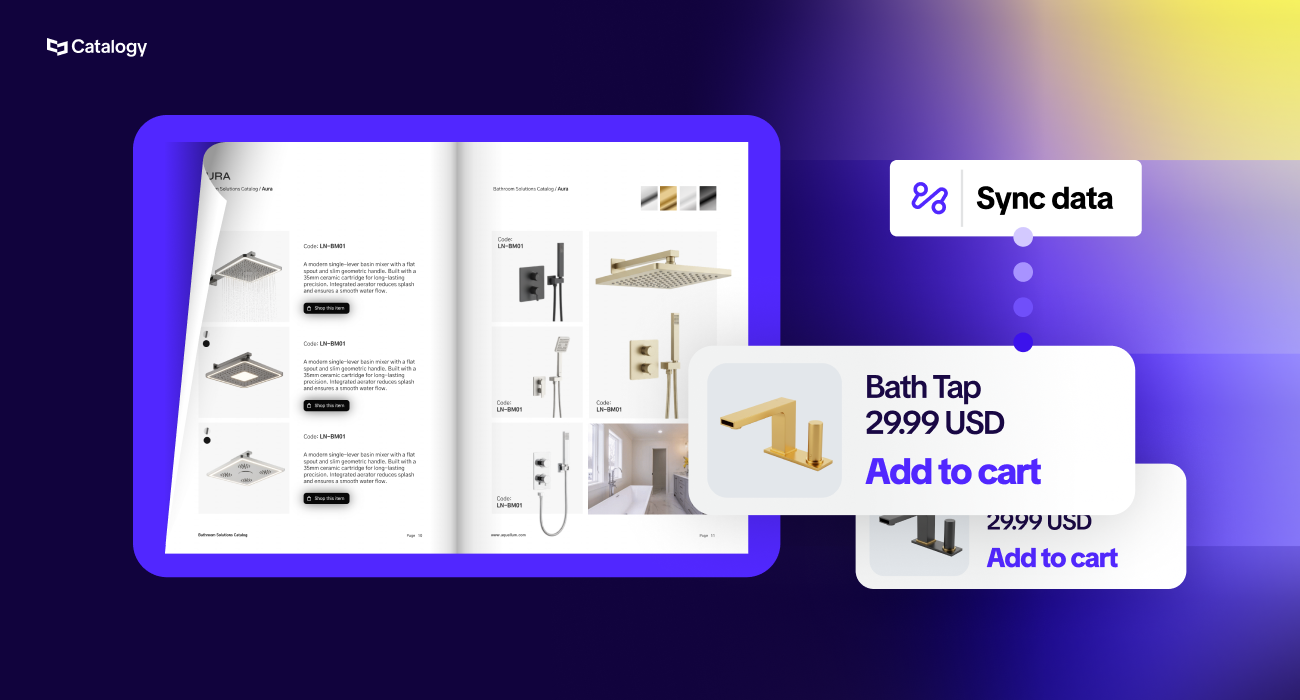
Through secure API-based synchronization, Catalogy connects directly to your ERP and PIM environment, allowing product information to flow automatically into your publishing workspace. Structured attributes, SKUs, pricing, descriptions, and media assets move seamlessly from your single source of truth into live digital catalogs.
Catalogy does not replace your core systems. It extends them. Your ERP or PIM remains the authority for product governance, while Catalogy becomes the controlled publishing layer built on top of validated data.
This integration delivers three strategic outcomes.
Your ERP or PIM remains the single source of truth.
Catalogy does not replace those systems. It extends them into customer-facing experiences.
No duplicated spreadsheets. No conflicting versions. No manual reconciliation.
Marketing no longer rebuilds catalogs from scratch.
Sales no longer questions price accuracy.
Regional teams no longer create independent versions.
Instead:
Catalog creation becomes part of a controlled workflow, not a repetitive task.
In dynamic industries, pricing and specifications change frequently.
Catalogy’s API enables:
New SKUs appear automatically.
Price adjustments reflect instantly.
Discontinued items disappear from live catalogs.
This is not just automation. It is synchronization.
After integration with Catalogy:
Catalog production evolves from manual execution to connected infrastructure.
For companies managing thousands of SKUs across regions, disconnected workflows generate measurable risk:
Integration eliminates those risks by connecting operational systems directly to customer-facing content.
Catalogy transforms digital catalogs into live extensions of ERP and PIM architecture.
ERP to catalog integration in Catalogy connects your enterprise resource planning system directly to the Catalogy publishing platform through structured, API-based synchronization. This integration ensures that validated operational data such as SKUs, pricing, stock availability, and technical specifications flows automatically from your ERP into your digital catalogs.
Instead of exporting spreadsheets or rebuilding layouts after every pricing change, Catalogy transforms ERP data into live, customer-facing catalog content. When updates happen inside your ERP, Catalogy reflects those changes in a controlled and scalable way.
A Product Information Management system centralizes and enriches product content across departments and markets. It standardizes descriptions, attributes, localization, media assets, and taxonomies.
When integrated with Catalogy, enriched product data flows directly from your PIM into structured digital catalog layouts without duplication or manual formatting. Marketing teams no longer copy product details into design files. Instead, Catalogy synchronizes validated product records automatically.
Yes. Catalogy’s API enables automatic synchronization between ERP or PIM systems and live digital catalogs.
When pricing changes, specifications update, or SKUs are discontinued inside your ERP, Catalogy syncs those changes directly into your catalog workspace. Updates can be reflected instantly or managed through internal governance workflows, depending on your configuration.
Catalogy’s API-driven architecture is designed specifically for enterprise-scale environments.
Organizations managing thousands of SKUs across multiple markets, languages, and currencies require structured synchronization and controlled publishing workflows. Manual catalog production cannot support that complexity.
No. Integrating ERP or PIM systems with Catalogy does not require replacing your current infrastructure.
Your ERP continues to manage operational data. Your PIM remains the authority for enriched product information. Catalogy integrates seamlessly with both systems, extending validated product intelligence into customer-ready digital catalogs.
.png)