

A shoppable product catalog is the most effective way for a modern brand to eliminate the friction that exists between seeing a product and buying it. For years, the industry relied on paper books and heavy PDF files to showcase inventory. These methods are now outdated. They create barriers between the seller and the buyer. Today, world-class organizations are shifting toward interactive experiences that turn digital discovery into immediate revenue.
At Catalogy, we provide the white-label infrastructure for this transformation. We do not just give you a design tool. We provide a premium service that turns your product list into a high-performance sales engine. In this guide, we will explore the seven things every modern product catalog should be to stay competitive.
The most important feature of any shoppable product catalog is the ability to buy directly from the page. In a traditional workflow, a buyer sees an item they like. They then have to leave the document to find it on your website. Or they have to call a sales representative. Every extra step is an opportunity for the deal to fail. Friction is the enemy of the modern sale.
Catalogy solves this by allowing you to add interactive "hotspots" or shopping buttons directly on your catalog page. When a buyer clicks a shopping button, they see real-time details in a popup. They can see pricing, descriptions, and current stock levels. You can also add item variations, each with it’s own price and visuals.
They can then add the item to a shopping list or cart. They never lose their place in the catalog.
By making it easy to act on interest immediately, you increase your conversion rates. This turns a simple browsing session into a direct transaction. For enterprise brands, this is a game-changer. It allows you to move at the speed of the consumer's intent. If a buyer is inspired by a lifestyle photo, they should be able to buy the items in that photo instantly. A shoppable catalog makes this possible. It bridges the gap between marketing and commerce.

Automated catalogs are a necessity in a fast-moving market. You cannot afford to wait weeks for a designer to finish a layout. A modern digital catalog must be connected to your data. This means your catalogs are generated and updated using the data you already have in your systems. Most large companies use a PIM (Product Information Management) or ERP (Enterprise Resource Planning) system.
With Catalogy, you can sync your product data directly from your source. We support database integrations via custom API, spreadsheets, and CSV files.
This automation allows your team to focus on strategy. They no longer have to waste hours on data entry. It ensures that your sales assets are always a perfect reflection of your inventory. If you are selling in 20 different markets with 20 different price lists, automation is the only way to survive without an army of designers.
Trackable digital catalogs give you visibility into what your buyers actually want. One of the biggest mistakes brands make is treating their catalog like something that you send and forget.
With a PDF, you have no idea who is reading what. You do not know which products are popular. You do not know if people are closing the file after the first page.
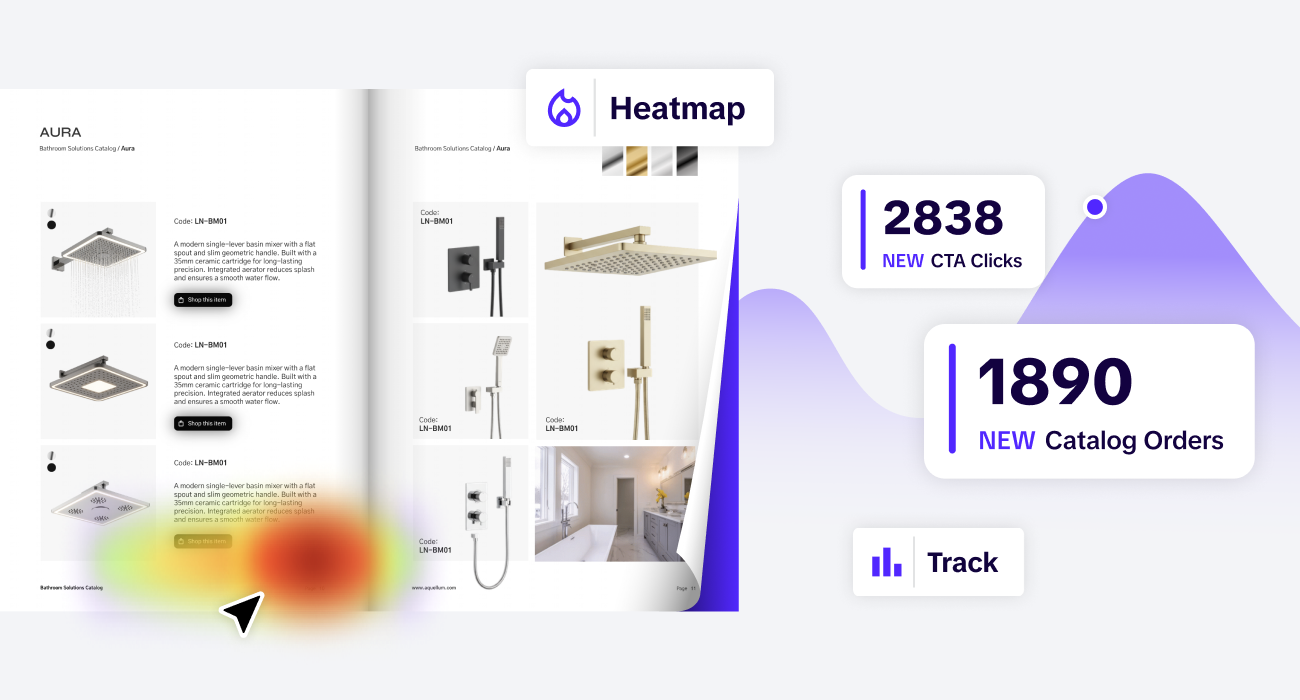
By using the analytics built into the Catalogy infrastructure, you see exactly how people interact with your pages. You can see which sections are the most popular. You can see which products get the most clicks.
This data is vital for your sales reps. If your team knows exactly what a prospect is looking at, they can follow up with a personalized offer. Instead of a "cold call," they are making a "warm call" based on real behavior. If a prospect spent 10 minutes on page 14 looking at industrial pumps, your rep knows exactly what to talk about before they even pick up the phone.
This data also helps you make better merchandising decisions. If a product is getting a lot of views but no clicks, you might need to adjust the price or the photo. If a page is being ignored, you might need to change its position in the catalog. You move from guessing what people want to knowing exactly what drives your revenue.
Engaging online catalogs must be an immersive experience. They should be more than just a series of flat images. To keep a buyer's attention, you need to use digital storytelling tools. Modern buyers expect more than just a digital version of a paper book. They want to interact with your brand.
A modern catalog maker like the one offered by Catalogy allows you to go far beyond simple page-turning animations. You can embed high-definition videos directly on the page. Imagine a clothing catalog where the model walks across the page, or a machinery catalog where you can see the engine in motion.
You can also include:
These features provide a "touch and feel" experience that digital catalogs usually lack. It makes your brand stand out in a crowded market. It gives the buyer a reason to stay on the page longer, which directly correlates to higher sales.
Searchable product catalogs are essential for a good user experience. If a buyer has to flip through 200 pages to find one SKU, they will give up. A modern digital catalog must be as easy to navigate as a high-end search engine. Time is the most valuable asset your buyer has. You should not waste it.
Buyers today are used to instant search. They expect to type in a keyword or a part number and see results immediately. Catalogy ensures your catalogs are fully searchable by name, SKU, or category.
We also include:
Smart navigation is the key to keeping high-value clients engaged. If a buyer can find what they need in five seconds, they stay in the "buying flow." If they cannot, they leave.
Mobile-friendly online catalogs allow you to sell anywhere. Your buyers are not always sitting at a desk. They are in showrooms, warehouses, and on the move. If your catalog is a 50MB PDF, it is impossible to read on a phone. It takes too long to download and the text is too small. This causes you to lose sales every single day.
Our catalogs are web-native and fully responsive. They adapt to fit any screen size. They work on 30-inch monitors and 6-inch smartphones. Images stay sharp and load fast. Buttons are easy to tap with a thumb.
Think about your sales reps in the field. They shouldn't be struggling with a laptop in a busy warehouse. They should be able to whip out a tablet or a phone and show the latest collection instantly. A mobile-friendly catalog ensures your brand is always accessible, no matter where your customer is.
Secure digital catalogs are a requirement for enterprise brands. You are often dealing with proprietary pricing or unreleased collections. You might have sensitive client data that cannot be public. A secure catalog ensures that your information stays in the right hands. You cannot simply email a PDF and hope for the best. Once a PDF is sent, it is out in the wild forever.
At Catalogy, we take security seriously. We offer a suite of tools to protect your business assets:
Moving away from the PDF is not just a cosmetic change; it is a financial one. When you look at the total cost of ownership for a traditional catalog, the numbers are often staggering.
Think about the hours your design team spends fixing typos, updating prices, and re-exporting files. Think about the cost of printing and shipping physical books that are out of date the moment they arrive. Catalog automation kills these costs. You spend less on "busy work" and more on creative marketing that actually drives growth.
Because a shoppable catalog is faster to navigate and easier to buy from, your sales cycle shrinks. You aren't waiting for a buyer to find a SKU or for a sales rep to send a quote. The transaction happens while the buyer is most interested. This increased "velocity" means more revenue in less time.
The goal of a shoppable product catalog is to make the buying process as smooth as possible. You want to remove every barrier between your product and your customer. By combining automation, analytics, and high-level security, you turn a simple marketing document into a professional sales infrastructure.
At Catalogy, we specialize in helping brands move beyond the "digital dead-ends" of the past. We provide the tools you need to act fast, sell more, and stay secure. If you are still relying on static files to represent your brand, you are leaving your revenue to chance. It is time to modernize your approach and turn your catalogs into your best sales tools.
It eliminates the hundreds of hours your team spends on manual work, including data entry and design revisions. By syncing directly with your PIM or ERP, you reduce errors and get your products to market much faster. This lowers your operational costs and increases your speed to revenue.
If you are an enterprise business, yes. If you have internal-only price lists or confidential product lines, you need SSO. It ensures that your sensitive data can only be accessed by verified users in your organization. It prevents your proprietary data from leaking to competitors.
Absolutely. Many of our clients use "Shopping Lists." This allows wholesalers to build bulk orders directly from the catalog. These lists can then be sent to the sales team as a purchase order or a quote request. It makes the wholesale process much faster for both sides.
The best way is through integrated analytics. By using a trackable digital catalog, you can see exactly which items are being clicked. You can see how much time a user spends on a specific category. This allows your sales team to follow up with a warm lead instead of making a cold call.
Yes. Unlike PDFs, which are hard for search engines to index, our digital catalogs are web-native. This means the text is searchable by Google. When people search for your specific SKUs or product names, your catalog can show up in the results. This brings more organic traffic to your products.
Yes. Modern catalog systems are built to be part of your tech stack. You can connect your catalog data to systems like Salesforce or Hubspot. This allows your sales team to see catalog engagement right inside the customer's profile.
If you already have a structured data source (like a spreadsheet or PIM), the transition can be very fast. Most of our clients are up and running with their first automated catalog in a matter of days.
