Published on: April 1, 2026
Picture a typical wholesale or distribution sales cycle. A buyer asks for your latest catalog. Someone on your team exports a PDF from your ERP, attaches it to an email, and sends it. The buyer downloads it, opens it on their phone, can't read the tiny product codes, and emails back three questions about stock availability and pricing variants.
Meanwhile, your product data has already changed.
This is the silent productivity killer inside thousands of B2B, wholesale, and manufacturing businesses. Static catalogs, PDFs, printed booklets, and PowerPoint decks are disconnected from your live inventory, your pricing tiers, and your product variants. Every update requires a manual rebuild. Every order requires a back-and-forth. Every sales rep works from a slightly different version of the truth.
A shoppable catalog software solves this by turning your product catalog into a live, interactive, commerce-enabled experience, one that syncs with your data sources, lets buyers add to cart or submit a quote directly, and gives your team analytics on exactly what buyers are looking at.
But not all platforms are built the same. Some are optimized for consumer retail. Others are built specifically for the complexity of B2B: product variants, account-level personalization, ERP/PIM integration, multi-market governance, and RFQ workflows.
This guide compares three leading platforms Catalogy, Publitas, and iPaper, with a focus on what actually matters for B2B wholesale and distribution teams.
Before diving into the comparison, it's worth defining what we mean. Shoppable catalog software is a platform that:
The category overlaps with catalog management software, product information management (PIM), and embedded commerce tools, and the best platforms in this space bring elements of all three together.
Before diving into the full breakdown, here's where Catalogy, Publitas, and iPaper stand across the seven dimensions that matter most for B2B and wholesale teams. Each dimension maps to a dedicated section below:
For B2B teams, the biggest operational pain point is keeping catalogs current. When you have thousands of SKUs, frequent price changes, and seasonal product variants, manual catalog updates are a full-time job.
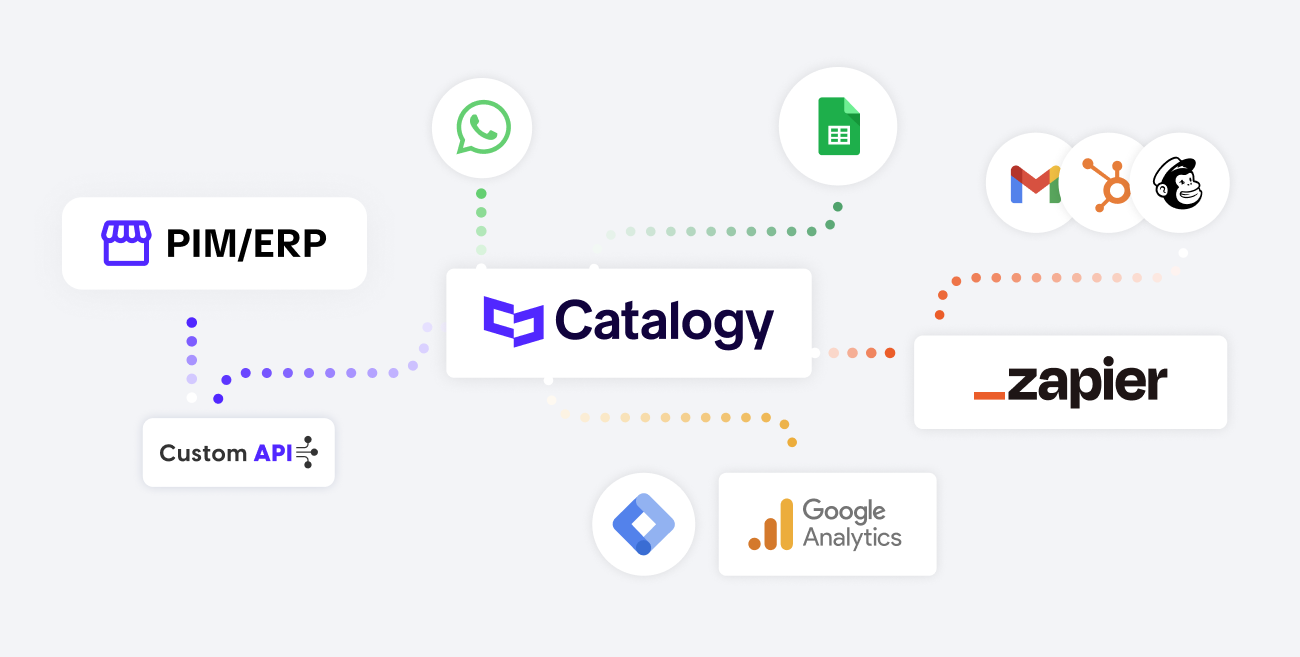
Catalogy is the strongest here for enterprise use cases. Its Scale & Automate tier connects directly to ERP systems, PIM platforms, and spreadsheet data sources to generate catalogs automatically. When your product data changes upstream, your catalog reflects it — no manual rebuild required. This is catalog management software and automation rolled into one.
Publitas supports product feed sync at its Gold tier and above, with SKU detection and automatic product updates when products change in connected stores (notably via its native Shopify integration). It's well-suited for retail product feeds but less explicitly documented for ERP/PIM connectivity at the enterprise level.
iPaper supports catalog creation from PDFs and product feeds via its Horizon product, with mobile/desktop auto-scaling. Feed-based automation is available but less prominently documented for complex ERP environments.
Bottom line for B2B: Catalogy is the clearest choice if your catalog must stay in sync with an ERP or PIM system across multiple product lines, markets, or business units.
One of the core requirements for a shoppable B2B catalog is letting buyers interact with product data, selecting variants, adding items, and initiating a purchase or quote, without ever leaving the catalog.
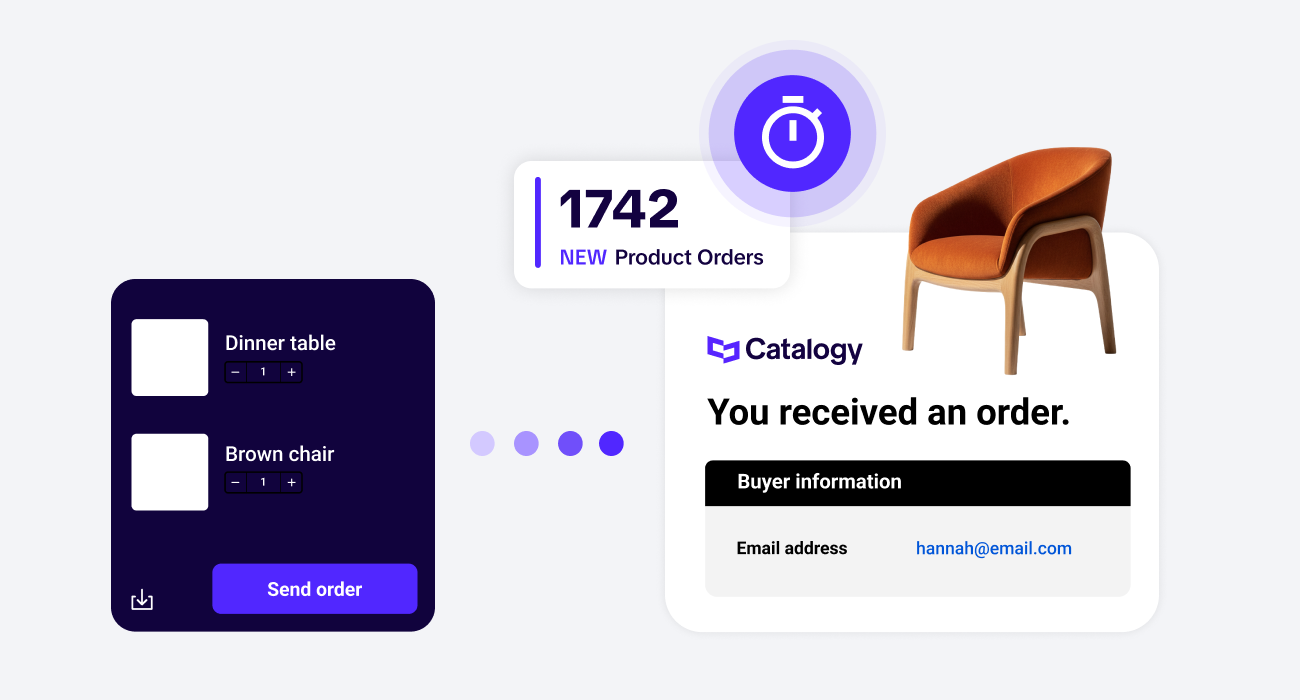
Catalogy supports product variants (size, color, SKU), an embedded buy button, add-to-cart functionality, and a full quote request / RFQ workflow. For Shopify users, Catalogy enables a Shopify Buy Button integration: buyers can browse the catalog, click on a product, and add it directly to their Shopify cart via a pop-up frame embedded in the catalog. The only moment they leave the catalog is at final checkout. This is a clean, friction-reducing experience that keeps buyers inside your branded catalog environment for as long as possible.
Beyond Shopify, Catalogy supports order intake via WhatsApp and Slack, and connects to broader workflows via webhook or API — useful for B2B teams that need order notifications to flow directly into their operations stack.
Publitas offers product overlays at the Gold tier and above, with a shopping cart integration available on Enterprise (listed as "on-demand," meaning additional scoping may be required). WhatsApp and email checkout options are also available at the Enterprise level.
iPaper has the most explicitly documented checkout mechanics of the three: a native basket inside the catalog, WhatsApp checkout, email checkout, iframe popup checkout, shop export to webshop basket, and a JavaScript API for adding items directly to a webshop cart without any page redirect. For retailers who need maximum checkout flexibility, iPaper's documentation is unmatched.
Bottom line for B2B: Catalogy's Shopify Buy Button integration, combined with RFQ workflow and WhatsApp/Slack order intake, covers the most common B2B purchase paths cleanly. iPaper wins on raw checkout option variety if your team needs multiple simultaneous checkout paths with deep technical customization.
B2B buyers browse on phones. Field sales reps use tablets. A catalog that looks broken on mobile is a lost deal.
All three platforms claim mobile-friendly delivery. Catalogy emphasizes mobile-first interactive catalogs as a core use case, replacing store binders and printed lookbooks with mobile-accessible digital alternatives. iPaper's Horizon product explicitly states that layouts automatically scale for both mobile and desktop. Publitas states that publications are mobile and desktop-friendly across all plans.
Bottom line for B2B: Mobile responsiveness is table stakes across all three platforms. No meaningful differentiation here.
For B2B and wholesale, generic catalogs are a missed opportunity. A distributor serving 200 retail accounts doesn't want every account to see the same product set and the same pricing. Sales reps need to send account-specific catalogs instantly, without rebuilding anything.
Catalogy explicitly supports personalized catalogs tailored to specific accounts or territories a direct match for how B2B sales teams actually work. Combined with its wishlist and quote request features, Catalogy functions as a sales enablement platform, not just a catalog viewer.
Publitas includes personalization as part of its Enterprise plan, with bespoke A/B testing and optimization services also available at that tier.
iPaper does not publicly specify personalization features in the sources reviewed.
Bottom line for B2B: Catalogy and Publitas Enterprise both support personalization. Catalogy's account/territory framing is more directly aligned with B2B sales workflows.
The question isn't just which integrations exist, it's how deep they go.
Catalogy integrates with Shopify (Buy Button embed, product data display, cart and checkout flow), WhatsApp (order intake), Slack (order notifications), Zapier (broader app automation), and Google Analytics. The Shopify integration is a code-based embed using Shopify's native Buy Button it pulls live product data from your Shopify store and enables cart behavior inside the catalog, with checkout completing in Shopify's environment.
Publitas has a native Shopify integration (free for Gold tier and above) that pulls product data from Shopify, enables automatic product updates when Shopify products change, and publishes discovery content back to Shopify and other channels. Its integrations directory also includes Pepperi (B2B commerce), Klarna, Hotjar, Matomo, Adobe Analytics, and Google Tag Manager.
iPaper's integrations are centered on its webshop connectivity via JavaScript API and shop export. Specific e-commerce platform integrations (beyond webshop basket connectivity) are not fully enumerated in public documentation.
Bottom line for B2B: Publitas has the broadest publicly documented integration directory. Catalogy's Shopify + Zapier + Slack combination is the most operationally practical for B2B teams already using those tools. iPaper's JavaScript API is the deepest for custom technical implementations.
B2B catalog investments need to be justifiable. Which products are buyers spending time on? Which catalog links are converting to orders? What's the revenue impact of switching from PDF to shoppable?
Catalogy provides real-time engagement analytics (views, clicks, orders), trackable links and QR codes, product and revenue analytics, and AI-powered insights at its Scale & Automate tier. Google Analytics integration is available. This gives B2B teams enough data to build a real ROI case for catalog investment.
Publitas offers GA4 integration across all plans, with Google Tag Manager, an analytics dashboard, and ecommerce KPI measurement at Enterprise. It also integrates with Hotjar, Adobe Analytics, and Matomo.
iPaper provides built-in analytics, including page views, time spent, conversions, device breakdown, geo location, and heatmaps, plus Google Analytics and Adobe Analytics integrations. Its JavaScript API also allows subscribing to events happening inside the embedded catalog useful for engineering teams building custom analytics pipelines.
Bottom line for B2B: All three platforms give you enough analytics to measure engagement and justify ROI. Catalogy's explicit "revenue analytics" framing is the most directly useful for B2B teams reporting on catalog-driven orders.
This is where the platforms diverge most sharply and where the right choice depends on your organization's operating model.
Catalogy's pricing is custom and requires a sales conversation. Catalogy is not a plug-and-play tool. Its team handles data connections, branded templates, and integrations as part of onboarding, the goal is getting enterprise teams live in weeks, not having them spend months configuring a DIY system.
For large B2B teams with complex data environments (multiple ERP systems, thousands of SKUs, multi-market requirements), this managed model is often faster and more reliable than self-serve. The cost of internal implementation time on a DIY platform frequently exceeds the difference in licensing fees.
Publitas is the right entry point for teams that want to start quickly and self-serve their way up. Its Bronze and Silver tiers are genuinely accessible. iPaper's session-based pricing means costs scale with catalog traffic a consideration worth modeling carefully at high volumes.
For B2B and wholesale teams, the ROI of shoppable catalog software comes from two directions simultaneously.
Operational savings are the easiest to calculate. If your team spends 20+ hours rebuilding and redistributing catalogs every quarter, and a platform with ERP/PIM sync eliminates most of that work, you can put a real number on it. Multiply hours saved by fully-loaded hourly cost. Add any reduction in print and distribution spend.
Revenue lift is harder to model but larger in most cases. When buyers can browse a mobile-friendly catalog, select product variants, and submit a quote or place an order without leaving the experience, conversion rates increase. When sales reps send personalized, account-specific catalog links instead of generic PDFs, engagement increases. When you can track which products buyers spend time on and follow up accordingly, win rates increase.
For enterprise teams, even a 1–2% lift in catalog-driven revenue typically pays back the platform cost many times over. Electrolux, a company that uses catalog technology built on the same Flipsnack infrastructure that powers Catalogy, produces hundreds of catalogs across multiple countries. The operational leverage at that scale is substantial.
The pattern holds at mid-market too. Melissa & Doug replaced a fragmented, multi-platform ordering process with a single shoppable digital catalog cutting production time by more than 50% and generating a large portion of their sales through the catalog's shopping feature within the first two months.
When the buying experience gets easier, the numbers move.
The honest answer to why Catalogy stands out for B2B specifically is that it was designed with B2B complexity in mind, not retrofitted for it.
Consumer retail catalog platforms typically assume: one product feed, one market, one checkout flow, one brand. B2B wholesale and distribution reality looks different: multiple product lines, tiered pricing by account, territory-based catalog variants, sales reps who need to share personalized links on the fly, buyers who want to submit RFQs rather than check out immediately, and operations teams who need order notifications in Slack before they've opened their email.
Catalogy's feature set maps to that reality. Product variants and buy buttons for buyers who are ready to transact. RFQ and wishlist workflows for buyers who need approval cycles. Account and territory personalization for sales teams managing complex customer relationships. ERP/PIM connectivity so the catalog never drifts from the truth. Shopify integration for brands running B2C and B2B channels in parallel. WhatsApp and Slack for the order intake and notification workflows your operations team already uses.
And because Catalogy's onboarding is managed, not DIY, enterprise teams don't spend months configuring a system. Catalogy's team handles the data connections and branded templates, so you go live faster and with higher-quality output than most internal teams would produce working from scratch.
.png)
If you're evaluating shoppable catalog software for a B2B wholesale, distribution, or manufacturing business, here is the honest summary:
Choose Catalogy if you're an enterprise with product-heavy catalogs, ERP/PIM data you need to stay in sync, a sales team that needs account-level personalization, and a preference for a managed implementation partner rather than a DIY tool.
Choose Publitas if you want self-serve pricing, a fast start, strong accessibility and security credentials, and a broadly documented integration ecosystem.
Choose iPaper if your primary requirement is flexible, deeply customizable checkout flows with multiple export paths, and your team has the technical capacity to work with a JavaScript API.
For most B2B teams reading this guide, Catalogy is the closest fit. It's the only platform in this comparison that combines catalog automation from enterprise data sources, B2B-specific sales enablement workflows, Shopify integration with embedded buy buttons, and a managed onboarding model designed for organizations with real data complexity.