

Published on: April 1, 2026
Catalogy is a professional catalog software platform purpose-built to replace manual workflows across every format modern sales and marketing teams rely on, from product catalogs and interactive catalogs to digital catalogs, online catalogs, lookbooks, fashion lookbooks, line sheets, and broader marketing collateral. It replaces static document production by connecting product data directly to catalog automation workflows, syncing with ERP and PIM systems, and deploying branded catalogs that update in real time.
DCatalog is most explicit about shopping experiences, with cart and checkout overlays connected to Shopify, WooCommerce, Magento, and Commerce Cloud.
FlippingBook's strength is converting a PDF to flipbook format and distributing interactive catalog content at scale, especially across teams, with features including embedding, updating, analytics exports, forms, quizzes, and, at higher tiers, password and email protection plus API and Zapier integrations.
DCatalog packages highlight digital publishing breadth, white labeling, templates, multilingual viewer, marketing tools, plus enterprise-only features like API integration and ecommerce capabilities, including add-to-cart, wishlist integration, and a customised shopping window.
Most enterprise catalog programs were not designed; they accumulated. A spreadsheet became a PDF. A PDF became a shared folder. A shared folder became a process no single team owns, updated on a cycle that no longer reflects your actual product range, and distributed through channels that generate no measurable commercial signal and offer no ROI visibility.
The consequences are familiar: sales teams working from outdated pricing, regional teams maintaining separate versions in parallel with no version control, buyers unable to act without picking up the phone, and no visibility into what content is actually driving revenue conversations. For businesses still relying on static PDFs, this is not a productivity problem it is a signal that print-to-digital migration has stalled.
The question for enterprise procurement and operations leaders in 2026 is not whether to digitise your catalogs. It is whether your catalog platform is capable of functioning as an operational system, one that connects to your product data, governs access across your organisation, and creates measurable pathways to purchase.
If you’re comparing enterprise catalog software or choosing a digital catalog platform, the real question is whether the tool works only as an interactive catalog publisher or as true catalog management software for a modern B2B catalog or wholesale catalog program.
Enterprise buyers, whether manufacturers, wholesalers, distributors, or retailers, need a platform that reflects the complexity of their operations, not a publishing tool bolted onto existing manual workflows.
A true enterprise catalog platform typically needs to deliver:
For enterprise teams, catalog software needs to do more than publish content. It has to connect with product data, reduce manual work, support secure collaboration, and help buyers move from browsing to action.
The table below compares how Catalogy, FlippingBook, and DCatalog stack up across the requirements that matter most for modern enterprise catalog operations:
Feature lists only tell part of the story. What follows is a dimension-by-dimension look at where each platform genuinely leads, ordered by what enterprise buyers consistently prioritise first.
Enterprise teams should also evaluate whether the platform supports CSV import, product data feed, and reliable data synchronization for pricing data and inventory data across the full publishing workflow:
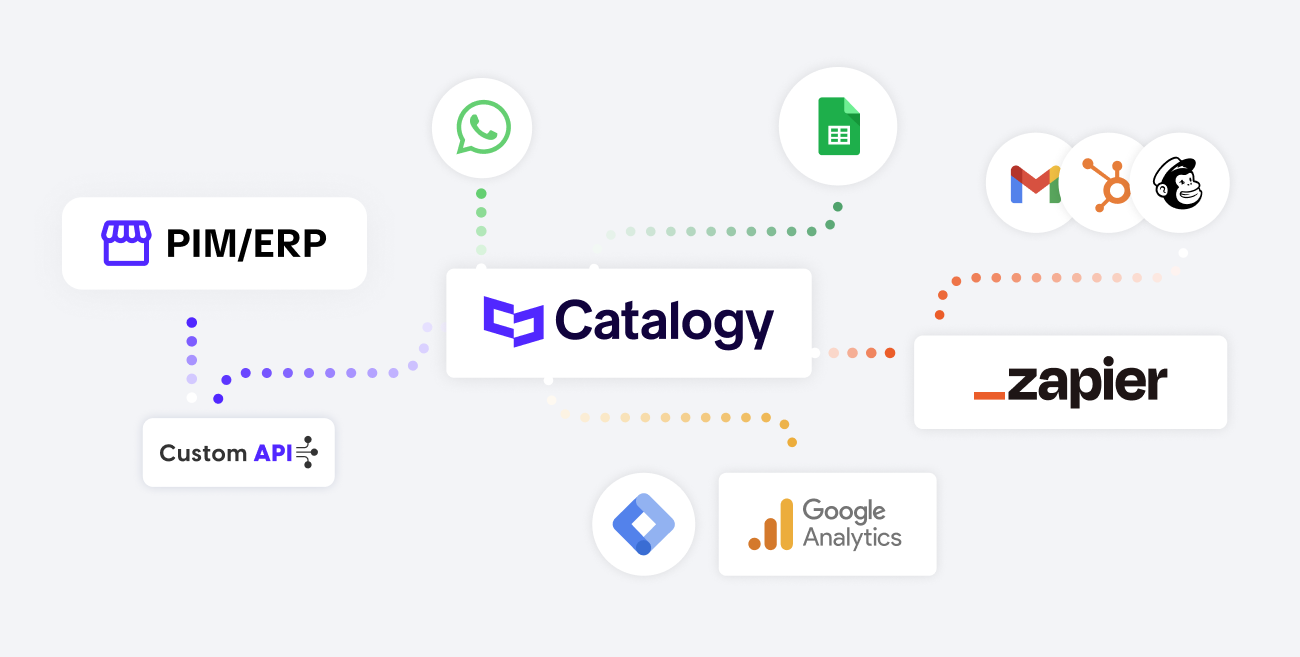
Catalogy is built around this problem. The Scale & Automate tier includes SKU-based detection, template-driven layout rules, and automated content updates triggered by changes in your product data. Catalogs are built from your data source not assembled from a file upload which means that when a product changes, the catalog reflects it without a separate publishing step. API access and Zapier connectivity are included for teams needing to connect catalog workflows to downstream systems.
FlippingBook offers the most thoroughly documented automation stack of the three platforms, with a public API specification, a webhook event model, and explicit tier-by-tier availability. Teams with developer resource and complex integration requirements will find more to work with in FlippingBook's published documentation than in Catalogy's. The trade-off is that FlippingBook's automation is built around document publishing workflows, not around product data or SKU management specifically.
DCatalog supports batch uploading and a REST API, and its Product Feeds offering is positioned at centralising product data from ecommerce platforms, PIMs, and spreadsheets. Webhook documentation is not publicly available, which limits visibility into its event-driven integration capabilities.
Where Catalogy leads: SKU-driven catalog generation and automated updates from product data. Where FlippingBook leads: depth and transparency of API and webhook documentation for developer-led automation workflows.
A catalog that is not connected to your product data is a liability. It will be wrong within weeks of publication on pricing, on availability, on variants and the cost of keeping it current falls on your team rather than your platform.
Catalogy positions ERP and PIM connectivity as a core architectural feature, not an integration add-on. The platform is designed to ingest product data feeds directly from your system of record whether that is an ERP, a PIM, a database, or structured data in CSV, XML, or JSON formats and perform true data synchronization to build catalog content from that source. ERP integration and ERP sync are treated as first-class capabilities: when your assortment or pricing changes upstream, the catalog reflects it.
This is the most direct implementation of data-connected catalog generation across the three platforms evaluated.
DCatalog's Product Feeds capability addresses a similar problem centralising product data feeds from ecommerce systems, PIMs, and spreadsheets and standardising them for catalog syndication and shoppable windows. It is a credible approach to data synchronization, though the implementation appears more services-led than native.
FlippingBook is primarily a PDF-to-interactive publishing platform. ERP or PIM connectivity is not part of its core positioning, and integrations in this area would require custom API work or third-party tooling.
Where Catalogy leads: native, documented ERP integration and ERP sync as first-class capabilities, supporting CSV import, XML, and JSON product data feeds within its enterprise tier.
.png)
Distributing catalog content across internal teams, trade partners, and external buyers requires more than a password. It requires a permissions architecture that is specific enough to reflect how your organisation actually works and robust enough to satisfy IT teams and procurement teams during a formal security review.
Catalogy is the only platform in this evaluation to explicitly market role-based access controls (RBAC) in the context of data-connected catalog operations. Administrators can define distinct permissions for different user types, internal teams, distributors, dealer networks, and external buyers rather than applying a single access level across the board.
SSO is supported for both teammates and external sharing. The platform supports approval workflows for content governance, and its infrastructure documentation covers AES-256 encryption at rest via AWS KMS, SSL/TLS in transit, DDoS protection via AWS CloudFront and WAF, and data hosted on AWS Virginia.
FlippingBook supports SAML-based SSO for both accounts and individual flipbooks, and documents TLS 1.2 and AES-256 encryption on AWS infrastructure. It is actively pursuing ISO 27001 certification, which will strengthen its compliance posture for regulated enterprise buyers once obtained.
DCatalog supports SSO via connection to an existing authentication system and offers password-protected or login-gated catalog sharing. Encryption specifics are not publicly detailed, and no uptime figure is published.
Where Catalogy leads: RBAC granularity, data residency transparency, audit trail support, compliance documentation, and a publicly stated uptime commitment. Where FlippingBook leads: overall security documentation clarity and an active ISO 27001 pursuit.
How a buyer moves from browsing a B2B catalog to placing an order varies significantly by account type, deal size, and market. Across the full buyer journey, from trade show browsing to post-meeting follow-up, a platform that supports only one checkout path will create friction for a meaningful share of your buyer base.
DCatalog offers the deepest native checkout integration of the three platforms, with a shopping window overlay that connects directly to Shopify, WooCommerce, Magento, and Commerce Cloud. Buyers can add items to the cart and complete a transaction without leaving the catalog. For enterprises running high-volume B2C or trade ecommerce on one of those platforms, this is a genuinely differentiated capability.
Catalogy takes a broader, channel-flexible approach to order capture that reflects the complexity of B2B selling across manufacturers, wholesalers, retailers, and dealer networks. Rather than a single embedded checkout, buyers engage through the mechanism that fits their workflow: email orders, WhatsApp integration for pre-orders, RFQ submission, CSV download for offline quoting, wishlists, or direct links to an existing webshop like Shopify. QR codes enable offline-to-online attribution from trade show materials and printed assets.
Lead capture forms and lead generation flows can be embedded directly into catalog pages, feeding sales teams with qualified intent data. Orders flow through to internal teams via Shopify integration, Zapier-to-CRM routing, or Slack notifications, making the catalog a genuine sales enablement tool, not just a browsing experience.
FlippingBook drives commerce primarily via outbound links to product pages and embedded order forms, a lighter-touch approach that works for teams where the catalog is a discovery tool rather than a transaction channel.
Where DCatalog leads: native embedded checkout connected to major ecommerce platforms. Where Catalogy leads: breadth of order capture channels for complex B2B selling motions, including mobile-friendly access for field sales and trade show teams.
Knowing that a catalog was opened is not the same as knowing whether it drove a commercial outcome. For enterprise teams, the analytics question is really two: what engagement data is captured, and can that data connect to the systems CRM, BI, or revenue tracking where decisions are actually made.
Catalogy tracks real-time views, clicks, and orders, and supports trackable links and QR codes for offline-to-online attribution across trade show and field sales activity. The engagement tracking layer is positioned as operational understanding what buyers are interacting with, not just how many opened the catalog. Marketing teams can use this data to attribute catalog engagement to pipeline activity. One area to validate in evaluation: whether analytics exports or BI connector integrations are available for deeper reporting, as this is not fully specified in Catalogy's current documentation.
Enterprises should also ask about heatmaps and lead generation reporting during scoping, as these vary by implementation.
FlippingBook has the broadest publicly documented analytics surface of the three platforms. Beyond standard engagement metrics, its API exposes tracked link statistics that can be piped directly into CRM integration workflows via API or Zapier.
Analytics exports are available on higher tiers. For teams that need catalog engagement tracking data to flow into existing reporting infrastructure with minimal custom development, FlippingBook's analytics stack is the most ready out of the box. SEO performance of embedded catalogs is also worth evaluating: FlippingBook's embeds are designed for discoverability.
DCatalog includes Google Analytics integration on its lower tiers and an Advanced Analytics Dashboard at Enterprise level, with source tracking for attribution. The specific event schema and export options are not publicly detailed, which makes it difficult to assess CRM integration depth without a technical scoping conversation.
Where Catalogy leads: real-time order tracking tied to commerce activity, QR code attribution, and lead generation visibility, not just content engagement.
For enterprise teams, branding is not cosmetic; it is a consistency requirement across every channel a buyer encounters. Marketing teams producing trade show materials, online catalogs, and wider marketing collateral need a platform that applies brand standards automatically, not manually, at scale.
All three platforms support white-label branding, custom domains, and reusable catalog templates at their enterprise tiers. The differences are in depth and flexibility.
Catalogy supports custom branding and branded catalog templates, with automation of interactive elements including product tags, videos, and shopping lists, meaning branded interactivity scales with your product range rather than requiring manual setup per catalog. The template library updates automatically when product data changes.

FlippingBook offers granular brand control at higher tiers: logo, background, favicon, custom navigation links, white-label content removal, plus multiple custom domains for teams managing separate brand presences. Embedded catalog experiences via FlippingBook are designed for SEO and discoverability, with customisable URL structures.
DCatalog includes white-label branding, a customisable toolbar, a custom domain, and Custom CSS access on its shoppable catalog pages, offering the highest ceiling for template customisation for teams with front-end resources.
Where platforms converge: all three are credible on branding for enterprise use. DCatalog's Custom CSS gives the deepest template customisation capability. Catalogy's advantage is that branded templates and the full template library scale automatically with data-connected catalog generation without a production step per update.
A platform's support model matters most at the point when your team is under pressure — during rollout, during a major catalog update cycle, or when an integration breaks. The question is not just whether support exists, but whether the vendor is structured to help you succeed or structured to help you self-serve.
Catalogy positions its onboarding as a co-built implementation rather than a documentation hand-off. Design specialists handle data structure and layout configuration, which reduces the time-to-value for enterprise teams who do not have internal resource to configure a new platform from scratch.
This is particularly relevant for rollouts involving ERP or PIM connections, multi-team permissions, and template systems the kind of deployment where generic onboarding documentation is not sufficient. Note that specific support SLAs and dedicated CSM inclusion are not publicly specified and should be confirmed during procurement.
FlippingBook offers the most structured and publicly documented support model: 24/5 chat and email support, priority support at the Advanced tier, and a dedicated account manager with VIP onboarding at Enterprise. For teams that value knowing exactly what support they are buying before they sign, FlippingBook's transparency here is a genuine advantage.
DCatalog differentiates support explicitly by tier email at Select, phone and email at Elite, and an account manager at Enterprise and supplements this with professional services including white-glove linking, custom scripting, and cloud deployment. For complex implementations, this services-led approach can accelerate delivery, though it also means that some capabilities are services-delivered rather than self-configurable.
Where Catalogy leads: Implementation depth and specialist involvement for data-connected rollouts.
For enterprise catalog programs serving large buyer audiences across geographies, infrastructure performance is not a background concern, it is a brand concern. A catalog that loads slowly or is unavailable during a sales campaign has a direct commercial cost. Page load speed is a baseline expectation for any buyer-facing catalog platform in 2026.
All three platforms are hosted on AWS infrastructure, providing a credible baseline for performance and resilience.
Catalogy's use of AWS CloudFront and WAF serves as a global CDN layer, distributing catalog content closer to buyers regardless of geography. Mobile-friendly delivery and mobile optimization are supported, ensuring the catalog performs consistently for buyers on mobile devices whether browsing from a trade show floor or reviewing assortments in the field.
FlippingBook confirms AWS hosting and positions its flipbook-style catalogs as fast-loading across devices, with a mobile experience optimised for touch navigation. DCatalog emphasises responsive HTML5 delivery and, for enterprise deployments, offers a private-cloud architecture option positioned at maximum performance for high-demand environments.
Where platforms are broadly equivalent: AWS-backed infrastructure across all three is a reasonable foundation. DCatalog's private-cloud option is worth exploring for very high-traffic deployments. Catalogy's CDN layer via CloudFront is the most explicitly documented for global distribution.
Catalogy offers two public plan paths ( Launch and Scale & Automate) but both are quote-based, so pricing is not listed publicly. Its model is clearly sales-led and custom, with likely costs shaped by integration scope, automation needs, governance requirements, and added services.
Enterprise buyers evaluating total cost of ownership should factor in implementation, data connectivity setup, and ongoing support when comparing against alternatives. ROI is best assessed against the reduction in manual production effort and the commercial value of real-time catalog accuracy. A demo or free trial scoping session should be requested before committing to understand implementation timelines.
FlippingBook is the most transparent on pricing, with public tiers and published annual-billing rates up to Enterprise custom. Even so, total cost of ownership can grow with usage limits, extra domains, more users, trackable links, or self-hosting needs.
DCatalog shows Select, Elite, and Enterprise plans, but public pages do not display numeric pricing. Its model is annual and based on per-active-link licensing, which can become expensive for teams running many live catalogs or microsites particularly when additional services such as custom scripts or deployment are added. A free trial or demo should be requested to validate the cost model against your catalog volume before committing.
Not every enterprise catalog program has the same problem. The right platform depends on where your operational gap is most acute and on being honest about the gap you are actually trying to close. Decision-makers should evaluate each platform against the profile that most closely matches their team, buyer base, and integration requirements, with scalability as a core criterion across all tiers.
Most enterprise catalog programs are not failing because of a lack of effort. They are failing because the tools were never built for the scale of the problem. A team manually exporting spreadsheets into PDFs, chasing regional teams for version approvals, and fielding buyer questions that a well-built catalog should answer automatically is not a process problem, it is a platform problem.
The platforms evaluated here each solve a distinct version of this challenge. If your priority is native embedded checkout on an existing ecommerce stack, DCatalog is worth a close look. If your priority is well-documented API automation across a large publishing team, FlippingBook Enterprise is a credible choice. But if the core problem is that your product data lives in one system and your customer-facing catalogs live somewhere else entirely updated manually, distributed inconsistently, and disconnected from any commercial outcome Catalogy is built for exactly that gap.
It is the only platform in this evaluation that treats catalog generation as a data operation rather than a design project: connected to your ERP or PIM, governed by role-based permissions, and structured to turn a product update into a published, distributable, trackable catalog without a production cycle in between. That is not a feature. It is a different way of running catalog operations and for enterprise teams whose current process is costing them more than they realise, it is worth a direct conversation.
.png)