
Product-focused companies deal with a lot of pressure. Marketing teams, channel managers, merchandisers, designers, and sales reps all work hard to keep product information accurate and ready to use. But many of them still struggle with messy spreadsheets, outdated PDFs, slow design processes, and internal systems that slow everything down. They know their current catalog process no longer matches the speed or needs of today’s business world.
A product catalog is how a company organizes, presents, and shares important product information with both internal teams and outside buyers. In 2025, a catalog is much more than a basic PDF. It has become a strategic sales tool, something that updates often, supports daily operations, and helps teams influence sales across different channels.
Catalogy was created to replace old catalog workflows with automated, interactive, always-up-to-date product catalogs that large teams can rely on. This guide breaks down what a product catalog means today, why traditional formats fall short, and how automation gives growing companies a clear advantage through Catalogy.
A product catalog functions as an organized system that explains what a company sells, why each item matters, and how customers or internal teams should interpret the information. Enterprises treat catalogs as more than a list of SKUs. A product catalog becomes a comprehensive reference structure that unites descriptions, pricing, attributes, specifications, imagery, media, and product variations.
Teams need catalogs that stay accurate across channels and devices. They expect relevance on mobile, desktop, and tablet. They expect interactivity. They expect analytics. They expect clarity. Static PDFs cannot deliver these expectations. They cannot update themselves. They cannot track performance. They cannot support complex product lines without large amounts of manual labor.
A modern digital catalog acts as the single source of truth. It adapts as the data changes, not months later. It removes guesswork and reduces friction across departments that depend on consistent product information.
Teams across industries describe the same challenges. Product changes spread through their workflow and force constant rework. Prices shift weekly. Designers rebuild layouts. Salespeople search for the correct version. Distributors receive inconsistent data. Product launches overwhelm existing systems. Every update disrupts someone’s day.
Static product catalogs create recurring issues, including:
• Slow updates that require design help
• Pricing mistakes that generate revenue loss
• Distributors sharing outdated versions
• Limited visibility into what customers view
• Seasonal launches that overload teams
• Storage systems with no reliable source of truth
• Departments working from different files
• Difficulty adjusting catalogs for regional needs
• Zero performance insights from PDFs
These problems appear for a clear reason. Older formats were built for a slower world. A modern catalog cannot live as a flat PDF that becomes outdated as soon as it is exported. It cannot remain an InDesign or PowerPoint file rebuilt each season. It cannot survive as a spreadsheet disguised as a catalog. It cannot depend on an old CMS. It cannot hide in email threads filled with disconnected PDFs.
These formats slow teams and weaken results. They create misalignment, confusion, and suboptimal outcomes. Growing companies need catalog systems that evolve with their data. Static tools cannot keep pace with a business that changes every week.
Contemporary catalogs operate as living systems. They evolve with product updates and support sales, marketing, and distribution in real time.
A modern digital product catalog should be:
• Fully interactive
• Searchable and easy to navigate
• Connected to real product data
• Instantly updatable
• Brand-consistent
• Mobile-friendly
• Shoppable or quote-ready
• Trackable with analytics and heatmaps
• Secure with viewer permissions
• Shareable through links or embedded formats
• Collaborative across departments
These qualities shape the new standard for product-driven organizations.

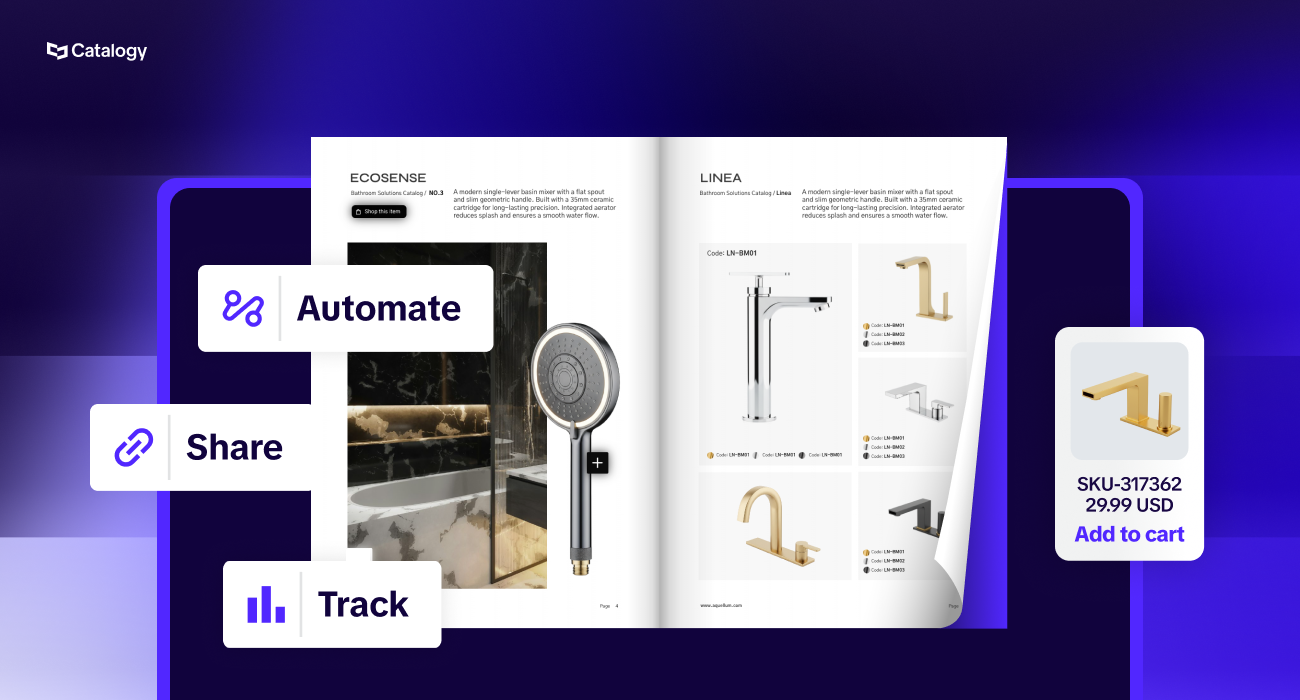
Catalogy transforms static PDFs into secure, interactive, continuously updated digital catalogs that improve buyer experience and reduce manual work.
Upload
Teams keep their current layouts. Catalogy uploads the existing PDF and prepares it for consistent branding, navigation, and optimization. No redesign. No reformatting. No new creative cycle.
Enhance
The PDF becomes a clickable experience. Product tags, videos, buttons, and branding elements appear. Every product becomes shoppable or quote-ready. Interactive zones help customers explore faster.
Share
The link stays the same. The catalog stays current.
Sales teams, distributors, and customers see one version. Catalogy supports secure access, internal permissions, QR codes, and embedded displays. Updates go live instantly.
Track
Analytics reveal how customers behave. Teams see impressions, clicks, product views, and time spent. AI insights summarize engagement patterns. Heatmaps highlight areas that attract the most attention.
Large product-driven organizations rarely rely on a single catalog. Their teams support distributors, retail partners, internal stakeholders, and end buyers across many markets. Catalogy gives them the flexibility to build and update every catalog variation from the same product data, with layouts that adapt automatically and interactivity that elevates the buyer experience.
Here are the catalog types high-volume teams can create inside Catalogy, along with why they matter and what capabilities they unlock:
Wholesale catalogs must help buyers compare units, evaluate specifications, understand pricing tiers, and build orders with confidence. B2B partners want a source of truth that stays accurate even during heavy promotional cycles or supply fluctuations.
With Catalogy, teams can:
• Sync pricing and availability automatically
• Present complex attributes in structured layouts
• Allow partners to add items to a shopping list and send quote requests
• Track page views, product interest, and buyer intent
• Publish updated versions without recreating the entire file
This gives wholesale buyers a consistent, reliable experience while reducing administrative load for internal teams.
Seasonal collections require speed and impeccable presentation. Old processes trap teams in long design cycles while new product launches demand real-time accuracy.
Catalogy allows brands to:
• Generate lookbooks in minutes using the Catalog Generator
• Include lifestyle imagery, embedded video, and product tags
• Sync product data as collections evolve
• Share lookbooks through QR codes, links, or embeds
• Track which items capture the most attention
This transforms seasonal launches from stressful marathons into smooth, predictable workflows.
Promotional periods often expose gaps in static workflows. Prices shift quickly. SKUs rotate in and out. Marketing teams race to keep everything accurate.
Catalogy supports promotions catalogs by enabling:
• Instant price updates through feed sync
• Rapid creation of short-term promo catalogs
• Shopping lists for faster order building
• Analytics that show which promotions perform best
• Precise control over expiration or access rules
Promotions become easier to run, easier to measure, and easier to scale.
Construction, manufacturing, and appliance brands rely on data-heavy catalogs. Buyers need dimensions, compatibility details, certifications, performance charts, and installation documents.
Catalogy makes this manageable by providing:
• Structured layouts for dense technical information
• Support for multiple document types and specification sheets
• Variant mapping for complex product families
• Automatic updates when technical data changes
• Precise asset governance across internal teams
This prevents errors and ensures customers always see accurate, up-to-date specifications.
Store associates and field teams need quick access to current product information. Many retailers still use printed binders that become outdated within days.
Catalogy replaces those binders with:
• A mobile-friendly, interactive digital binder
• Always-current product details
• Add-to-list features for clienteling workflows
• QR codes for instant customer sharing
• Page-level insights to understand what shoppers explore
Teams in stores gain agility, and customers see more relevant information.
Sales teams want catalogs that feel alive. They want something they can share confidently with buyers without worrying about outdated content or inconsistent information.
Catalogy equips sales teams by offering:
• One link for all conversations
• Personalized catalogs tailored to accounts or territories
• Interactive product cards with media and specifications
• Real-time analytics on what prospects view
• Easy embedding into CRM workflows
This improves sales alignment and strengthens every buyer interaction.
Training teams often struggle with scattered materials, outdated PDFs, and inconsistent onboarding experiences. Catalogy consolidates internal resources into structured, trackable catalogs.
Organizations can use Catalogy for:
• Product training manuals
• Installation guides
• Internal-only product sets
• Onboarding content for new employees
• Multi-market training versions
This creates a predictable environment where knowledge stays current and consistent across departments.
When product lines grow, manual work collapses under the weight of constant updates. Automation converts catalog creation from a slow administrative task into a fast, repeatable, reliable process. Automation integrates product data, visuals, and structure into catalogs that update themselves.
Your data feed becomes a catalog in seconds. Automation fills templates with real product information. The system includes multiple layout formats built for different product sets. Custom templates designed by the Catalogy team support advanced brand requirements.
A task that used to take weeks now takes minutes. Speed becomes a competitive advantage.
Catalogy connects directly to enterprise systems. These integrations synchronize product feeds with catalogs to keep data accurate. This creates a real-time connection between the system of record and the catalog.
Benefits include:
• No manual re-entry
• Reduced pricing errors
• Instant SKU updates
• Updated metadata and specifications
• Live variant mapping for complex items
Integrations make Catalogy a trusted operational layer.
Catalogy supports structured data feeds from CSV, XLSX, or Google Sheets. Feeds map all essential details, including SKUs, descriptions, prices, images, and variants. Auto-mapping accelerates setup. Syncing prevents outdated content and gives teams flexibility in how layouts appear.
Each update cascades across all catalogs without manual edits.
Catalogy helped leading global brands replace static PDFs with automated, interactive catalogs across multiple markets
Office 1 Bulgaria all faced the same problem: their product information was scattered across SAP systems, Excel sheets, old CMS tools, and regional folders. Each update forced teams to redesign pages, export new PDFs, and rush to fix mistakes. Sales teams often shared outdated files, and distributors passed around different versions. Seasonal launches added even more pressure to workflows that were already overloaded.
These brands needed a single system that could create interactive, data-connected catalogs in minutes catalogs that could handle thousands of SKUs, frequent price changes, and regional differences. Their catalog operations had become too large and too complex for static formats, and manual processes were slowing their growth.
Catalogy delivered a unified workflow designed for high-volume teams. Product data flowed into the platform through structured feeds and was matched accurately using automated attribute recognition. The Catalog Generator produced complete, branded catalogs within minutes, with layouts that automatically adapted to each market.
The impact was clear. Catalog creation time dropped from weeks to hours. Accuracy improved. Regional consistency increased. Sales teams gained confidence by sharing catalogs that never went out of date. Customer experience improved as catalogs evolved from simple PDFs into dynamic, data-driven tools.
Catalogy now gives these global brands a flexible, automated foundation that supports large product portfolios, regional complexity, and constant change. Their catalog operations run with a level of clarity, speed, and precision that wasn’t possible before.
Product-heavy companies now work in an environment where speed, accuracy, and teamwork affect every business result. Teams can’t rely on static PDFs that become outdated as soon as they’re exported. They can’t maintain trust with distributors or customers when old information is still being shared. And they can’t afford long production cycles during busy seasons when every detail matters.
Modern catalogs need to update themselves. They should help teams avoid simple mistakes. They should show how customers interact with products. They should adjust to price changes, new products, and different market needs without slowing entire departments down. Automation makes this possible. It removes catalogs from slow redesign cycles and keeps them in a controlled, predictable system that grows with the business.
Catalogy helps teams work with more clarity, accuracy, and speed. It creates living catalogs that always stay current, reducing friction between marketing, sales, and distribution. Companies that switch to automated catalogs gain a clear advantage in every product cycle.
If your teams still rebuild catalogs every season or deal with inconsistent product data, now is the time to simplify everything. A short conversation with our specialists can show how modern digital catalogs boost sales, cut manual work, and improve internal alignment.
